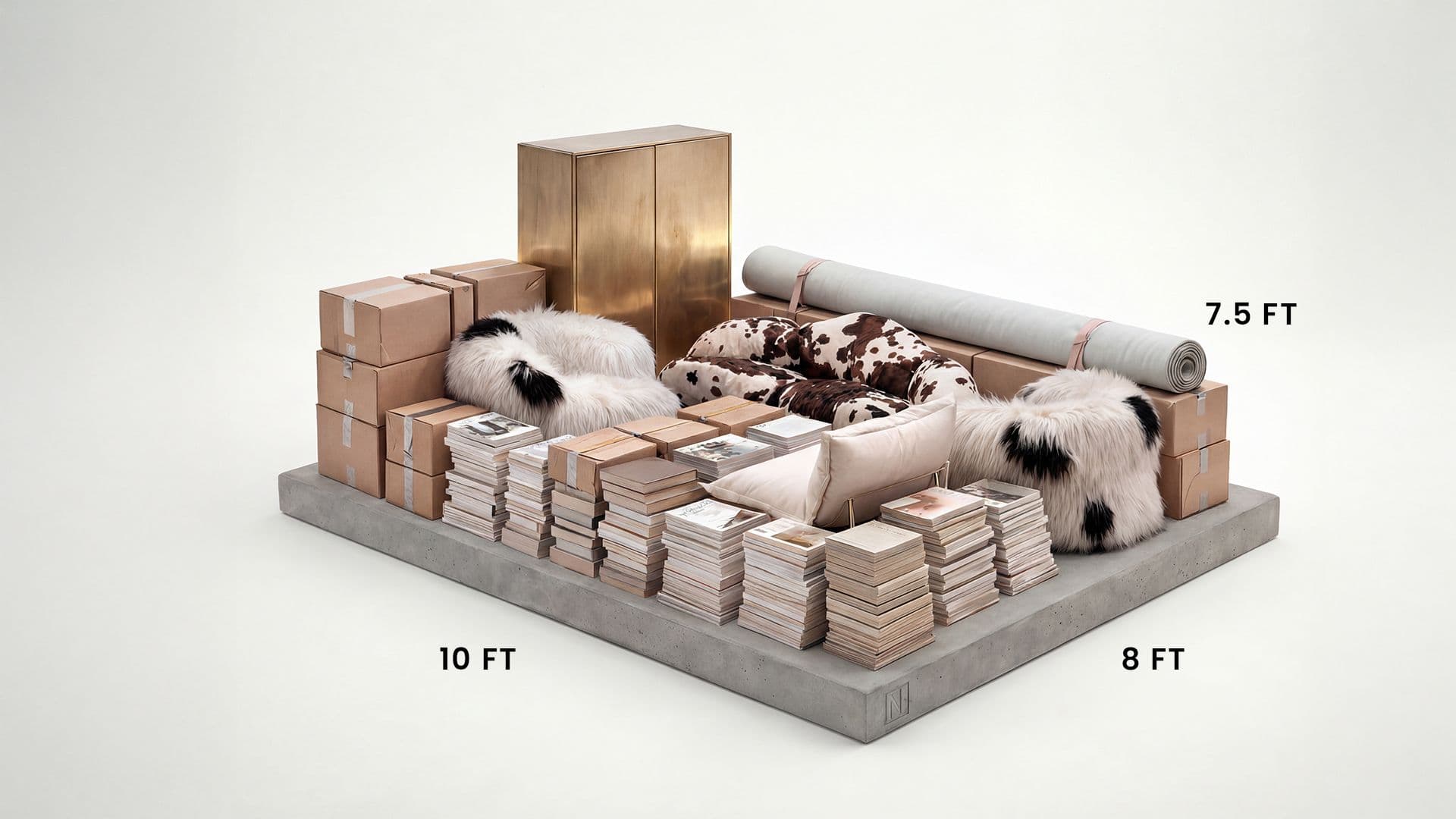

A 10×10 storage unit is 100 sq ft of floor space (10 ft wide × 10 ft deep × ~8 ft high = roughly 800 cu ft). Think of it as a small bedroom that comfortably holds the contents of a 1–2 bedroom apartment — furniture, boxes, and all — making it the most popular size for moves, renovations, and household transitions.
This guide gives you the real numbers, a visual diagram, three practical lenses for thinking about what fits, and honest guidance on when to size up or down.
10×10 Storage Unit Dimensions: The Numbers That Matter
A standard 10×10 storage unit is 10 feet wide by 10 feet deep, giving you exactly 100 square feet of floor space. With ceiling heights typically running 7.5–8 feet, that works out to 750–800 cubic feet of usable volume.
To put that in terms that actually mean something, it's roughly the same footprint as a small bedroom in a New York City apartment. If you've ever stood in a 10×10 room and thought "this is actually kind of tight," that's your mental reference. It's more space than it sounds, but less than people often assume when they're trying to fit an entire apartment into it.
Here's how the 10×10 stacks up against our other sizes:
25 sq ft = 5x5 = Small walk-in closet or one bedroom's overflow. 100 sq ft = 10x10 = Small bedroom or 1–2 bedroom apartment contents. 150+ sq ft = 10x15 or larger = Full apartment or multi-bedroom home contents.
Size in context
A 10×10 is exactly four times the floor space of a 5×5. If you've read our 5×5 guide and thought "I need twice that," you actually need a 10×10.
What Fits in a 10×10 Storage Unit
The same 100 sq ft means different things to different people. Here are the three lenses that cover most use cases. Find the one that fits your situation.
The Apartment-Equivalent Test
This is the most useful benchmark for most New Yorkers. Here's what a 10×10 can realistically hold, by apartment size:
- Studio apartment — Entire contents including bed, sofa, coffee table, dresser, 20–25 boxes, lamps, rugs, kitchen items will fit well
- 1-Bedroom — Full contents with good packing including queen bed, living room furniture, 30+ boxes, small appliances will fit snugly
- 2-Bedroom — Contents minus large pieces and will need to leave behind oversized sectionals or double beds.
- 3-Bedroom — Not enough room, so consider a 10×15 or two 10×10 units
Common Use Cases
People storing in a 10×10 in NYC typically fall into one of these situations:
- Moving & Transition: A 10×10 holds a full apartment's worth during the gap.
- Furniture Overflow: A 10×10 keeps a living room and bedroom set safe while you figure things out.
- Mid-Size Business Inventory: A 10×10 is a serious stock room with space for shelving units, product pallets, and packing materials.
- Home Renovation: A 10×10 holds an entire room's furniture and boxes so your renovation can actually happen.
- Long-Term Downsizing: A 10×10 gives breathing room while making decisions about what to keep, sell, or donate.
- Studio or Creative Storage: Artists, photographers, and makers needing space for equipment, canvases, props, or production materials that won't fit in a city apartment.
What Does NOT Fit in a 10×10
It's worth being honest about the limits. A 10×10 is big, but it has a ceiling — literally and figuratively.
Fits Comfortably:
- Queen bed frame + mattress
- Sofa + armchair + coffee table
- Dresser + nightstands (×2)
- Dining table + 4 chairs
- 30–40 medium moving boxes
- Bookshelf + wardrobe
- Small appliances (microwave, lamps)
- Bikes (1–2) + remaining boxes
- Business shelving + pallets
Won’t Fit:
- Full 3-bedroom apartment contents
- Large sectional sofa + full furniture set
- Grand or upright piano
- Vehicles or large recreational gear
- Multiple large appliances (washer + dryer + fridge)
- Home gym equipment + apartment furniture
- Commercial inventory at scale
If you're landing in the "won't fit" column, it may be time to look at a larger unit or consider what can be sold or donated before your move. Our full sizing guide walks through every size we offer, from 12 sq ft up to 80 sq ft.
Need storage?
Check available Urban Stash units near you.
Is a 10×10 Storage Unit Big Enough?
A 10×10 is the right size if you're storing the contents of one full apartment (up to a 1-bedroom), running a small-to-mid business from storage, or holding furniture through a renovation or transition. It's also the right size if you know you need more than "a bedroom's worth" but don't want to overpay for a 10×15.
Size up to a 10×15 if you have a 2-bedroom apartment's worth of large furniture, multiple appliances, or a growing inventory that will expand over your rental term.
Size down to a 5×10 if you're mostly storing boxes and a few pieces of furniture, not full room sets.
Urban Stash tip
When in doubt, sketch your items on paper before booking. List every piece of furniture by approximate dimensions, then estimate box count. If your total floor footprint (furniture laid flat) exceeds 80 sq ft, you'll need the stacking and packing discipline of an experienced mover to make a 10×10 work, or step up a size. It's always cheaper to rent the right size the first time than to transfer mid-contract.
10×10 Storage Unit Cost in NYC
New York City storage prices are higher than national averages. For a 10×10, you're generally looking at $200–$400/month depending on neighborhood, climate control, and facility type. Premium locations in Manhattan's most sought-after neighborhoods will trend toward the top of that range.
At Urban Stash, large units, including our 10×8 format (the closest equivalent in our current inventory), start from $320/month. Pricing is listed transparently on each location page, with no hidden fees and no minimum contract length.
Urban Stash Large Unit Pricing Large units from $320/month. No long-term commitment. Keyless phone access. 24/7 monitoring included.
What to Know Before You Book a 10×10 Storage in NYC
For New York City specifically, a 10×10 storage unit is the workhorse size. It's large enough to hold a meaningful amount of furniture and boxes, but urban storage facilities don't always offer a true 10×10 due to building constraints. It's worth checking the actual dimensions listed for each unit, since some facilities advertise "10×10-equivalent" units that are configured differently (e.g., 10×8 or 8×12).
At Urban Stash, exact unit dimensions are listed on each location page so there are no surprises when you arrive. And because our facilities are located within neighborhoods, not on the outskirts of the city, you can visit your unit whenever it's convenient, not just when you can block out half a day.
Frequently Asked Questions
How big is a 10×10 storage unit? A 10×10 storage unit is 10 feet wide by 10 feet deep — 100 square feet of floor space. With ceiling heights of 7.5–8 feet, total volume is approximately 750–800 cubic feet. It's roughly the same footprint as a small bedroom in a New York City apartment.
What fits in a 10×10 storage unit? A 10×10 comfortably holds the contents of a studio or 1-bedroom apartment: a queen bed frame and mattress, sofa, coffee table, dresser, dining table and chairs, 30–40 medium boxes, lamps, and smaller items. With smart packing, it can stretch to hold most of a 2-bedroom apartment's contents, minus oversized furniture.
Is a 10×10 storage unit big enough for a 2-bedroom apartment? It depends on your furniture size. A 10×10 can hold a 2-bedroom apartment's worth of items if you pack tightly, stack vertically, and don't have oversized pieces like king beds, large sectionals, or multiple bulky appliances. For a comfortable fit with a full 2-bedroom, a 10×15 is a safer choice. See our sizing guide for a full comparison.
How much does a 10×10 storage unit cost in NYC? In New York City, 10×10 storage units typically run $200–$400/month, depending on neighborhood and amenities. At Urban Stash, large units start from $320/month with no long-term contract. Check current availability for live pricing by location.
What's the difference between a 10×10 and a 10×15 storage unit? A 10×15 adds 50 square feet means 50% more floor space which makes a meaningful difference when storing large furniture, appliances, or a 2–3 bedroom apartment. The 10×10 is the right choice for most 1-bedroom apartments and studios. If you're at all uncertain, the 10×15 avoids the hassle of upgrading mid-rental.
Can a 10×10 storage unit hold a sofa? Yes, a standard 3-seat sofa fits in a 10×10. Stand it on its end (cushions removed) to reclaim floor space, or place it flat against the back wall as a base layer. Large sectionals or L-shaped sofas with a chaise are trickier and may take up too much floor space to still fit your other items comfortably.
How do I pack a 10×10 storage unit efficiently? Use the floor plan intentionally by leaning flat items like mattresses, tabletops and mirrors vertically against walls first. Then build box columns from floor to ceiling using uniform box sizes. Place furniture you won't need to access along the back, and keep a narrow center aisle for reaching items stored deeper in. Label every box on at least two sides. Disassemble bed frames and dining tables — the extra 15 minutes saves significant floor space.
Does Urban Stash offer 10×10 units in NYC? Urban Stash offers large-format units in NYC, with exact dimensions varying by location. Our current listings include configurations up to 10×8 (80 sq ft) and larger. Check available units by neighborhood for current inventory, dimensions, and pricing. All unit specs are listed transparently so you know exactly what you're booking.
Ready for more room?
Find a storage unit that fits your stuff
Browse available units, compare sizes, and reserve online in a few minutes.
Written by
Urban Stash Team
Storage notes, city-living ideas, and practical ways to make more room for what matters.